Diff-Aware Prompt Engineering After a Production Incident
Comparing traces pinpoints the instruction gap, so you fix only that.
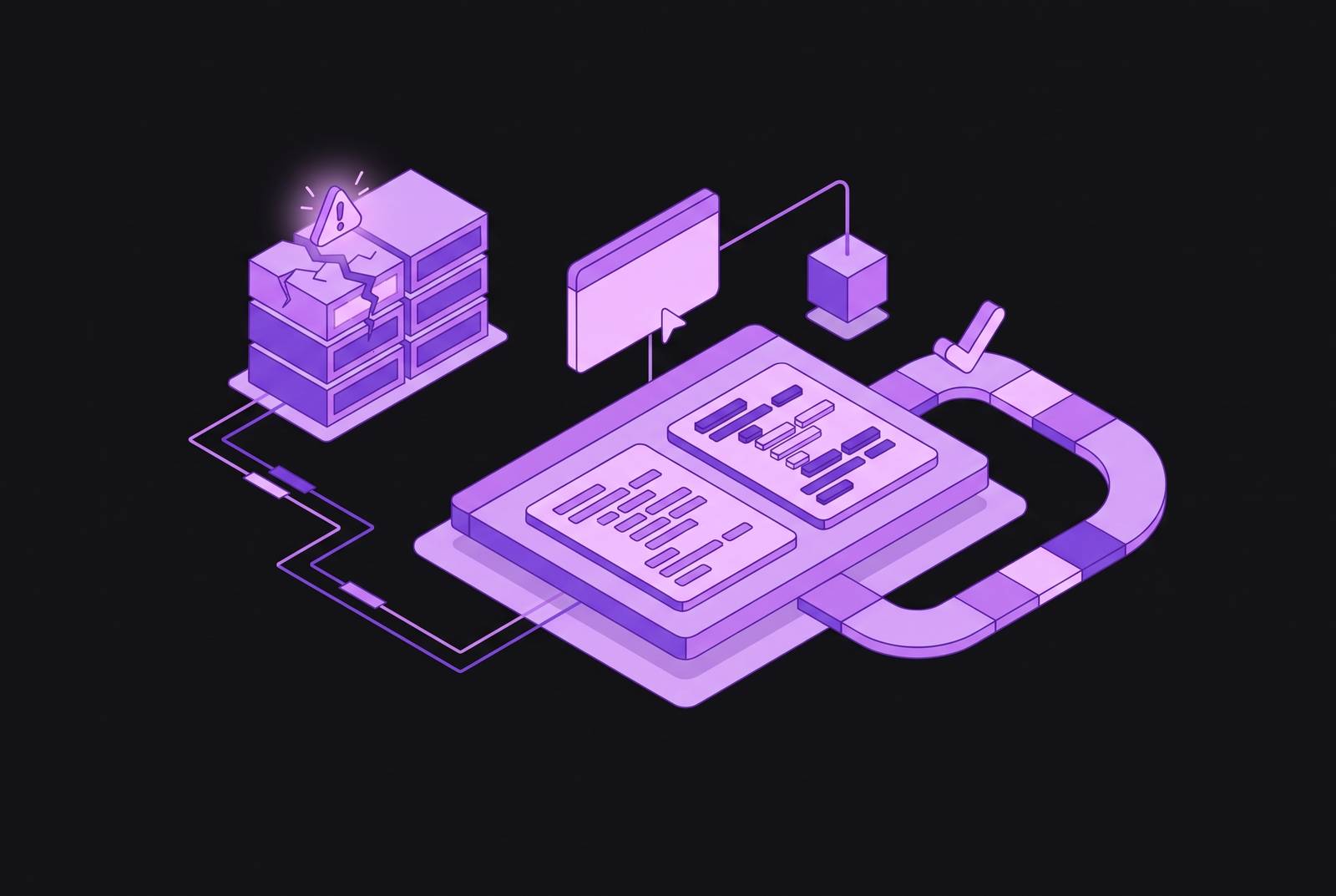
Traditional error monitoring fails for AI agents because a request that succeeds does not prove that the agent made the right decision. An agent can return HTTP 200, complete its workflow, and still give users the wrong outcome without triggering a crash or timeout alert. Diff-aware prompt engineering after a production incident addresses that gap by comparing execution traces, isolating the instruction gap, and changing only what the evidence supports.
Why does an AI agent look fine in logs but give users bad outputs?
A production incident can reveal a failure that infrastructure metrics never registered. The agent routed work to the wrong queue, cited a hallucinated policy, or completed a task with the wrong outcome. The workflow finished, but the decision was wrong. Conventional monitoring watches for crashes, timeouts, and 500s, so the first signal of this semantic failure may instead be a user complaint, a support escalation, or a billing discrepancy.
In the logistics routing case, a downstream API renamed incident_count to num_incidents, so every routing decision after that was based on missing context. No error log or alert exposed the change. Everything stayed green until a human noticed that the outcomes had drifted. The monitoring had no mechanism for detecting that failure category.
That distinction changes how detection time should be understood. Observability failures with no detection mechanism have no mean-time-to-detect by definition. Sherlocks' 2026 production incident analysis found an average mean-time-to-resolve of 4.2 hours for this category, far longer than for failures with even minimal instrumentation. The missing signal also makes diagnosis harder.
What the incident trace actually contains that intuition does not
A production trace records the context available to the agent at each step, the tool arguments it constructed, and the raw response it received. It also exposes the recorded path between the agent's stated plan and its action. These are distinct pieces of evidence. Together, they separate what the agent actually had from what the team assumed it had, which is the necessary starting point for a prompt fix.
As the logistics case shows, a response can arrive successfully but lack the information the agent needs for its next decision. A successful call is not sufficient evidence. Without the raw response, a team may blame poor instruction-following for the outcome when missing context was what went wrong. Without the action that followed, the team cannot tell how that missing context changed what the agent did.
Tool arguments show what the agent asked for before the tool ran. If the arguments were already wrong, looking only at the data the tool returned starts the investigation too late. The trace preserves that earlier decision point. Similarly, a recorded plan can be consistent with the task while the action taken diverges from it. That mismatch points toward a different instruction gap than either bad retrieval or a changed response schema.
In a long workflow, a small parameter error at step 2 can feed into step 3, make step 4 go wrong, and leave the final output completely wrong by step 15. Each step may still look right on its own. The trace shows the chain, but it does not by itself identify which difference explains the incident. That requires comparison with a run in which the relevant behavior worked.
How to read a trace diff to isolate what the incident actually changed
To extract that evidence, compare a pre-incident trace with a post-incident trace at the same workflow step. Align the steps before judging their differences. Compare the context window, tool arguments, and intermediate outputs at each point, rather than starting and ending with the final responses. Locate the first relevant divergence.
Start with changes in the context available to the agent. Inspect the retrieval results for different data, a stale document, or a field that no longer exists in the schema. Then examine the arguments constructed for the corresponding tool call and identify where any argument drift began. Keep these two questions separate during the comparison. A changed request and a changed response may both affect the outcome, but they indict different parts of the workflow.
Next, compare the agent's stated plan with the action recorded at that step. A plan to use the relevant context does not establish that the action used it. Where the action diverges from the plan, the instruction gap concerns execution consistency in using the available information. Where the context itself changed, inspect whether the prompt implicitly relied on a field name or structure that no validation caught.
In the logistics case, the decisive comparison would place the raw API responses before and after the rename next to the corresponding routing steps. The earlier response would have incident_count, while the later response would have num_incidents. That is the schema difference to investigate first. Comparing the subsequent context and routing action would then show where the agent proceeded without the information on which its decision depended. Comparing final queue assignments alone would reveal the symptom without locating this boundary.
The diagnosis should name both the changed input and the behavior that failed in response. “Routing became unreliable” is too broad to guide an edit. “The agent continued routing when the expected field was absent after a schema rename” identifies a specific instruction gap. It also distinguishes the external change from the prompt behavior that needs correction. The diff is useful precisely because it narrows a production outcome to a decision that can be changed and tested.
Scoping the edit: why the diff should determine what changes and what stays
Once the gap is identified, the edit should change only the instruction the evidence indicts. Everything else should remain intact unless the comparison also exposes a fault there. This is a practical constraint on regression risk. Tightening tone, adding general caveats, and restructuring the system prompt at the same time introduces new behavioral changes unrelated to the known failure.
The appropriate edit follows from the kind of divergence the trace reveals. For an absent or renamed schema field, add an explicit instruction governing what the agent should do when that condition occurs. For ignored retrieval context, add an instruction to surface context provenance and flag staleness. These fixes address different decision boundaries. Combining them just because both deal with context would change more than the evidence calls for.
If the trace shows goal drift in a long chain, add a re-anchoring instruction at the specific step where it is needed, keeping the global task unchanged. If the action contradicts the stated plan, require the agent to verify its next action against that plan before execution. Location is part of the fix. An instruction at the step where the failure arose gives the next evaluation a specific behavior to check.
A broader rewrite can be justified when the diff reveals that the original prompt's structure is fundamentally mismatched to the task. It should not be the default response to an incident. Scope should follow evidence. A minimal edit preserves attribution because a changed behavior can be evaluated against the instruction that changed. A rewrite makes it difficult to establish which modification produced either an improvement or a regression.
Version control preserves that attribution beyond the immediate response. Untracked edits can accumulate until the prompt in production is no longer the one that passed evaluation. Prompt drift can itself cause a failure in production. Pairing a diff-scoped edit with a recorded version keeps the tested instruction identifiable as later changes arrive.
Applying the fix inside the toolchain where agents run
A versioned, runtime-fetched prompt registry makes this workflow more reliable than keeping the prompt in source code. The scoped edit can be labeled and pushed to production independently of a full redeployment. Each trace can then identify the exact prompt version that produced it. That association is essential for detecting regressions. It connects a change in behavior to the deployed instruction rather than leaving the team to infer which prompt was active.
MCP can connect the investigation to the editing environment. The same connection that surfaces a trace can pass its context to a coding agent, allowing a detected issue to move through a proposed fix to an opened PR. The trace need not remain a dashboard item. This path makes the evidence available where the corrected instruction is written, while the proposed change remains bounded by the diagnosis.
Framework instrumentation records the details of how the agent ran that this path needs. LangSmith's LangChainTracer callback handler captures per-step traces for LangGraph and LangChain workflows. LangGraph Studio v2 supports local replay of production traces so the comparison can run against the exact execution environment. This supports investigation before the edit ships.
The OpenAI Agents SDK provides built-in tracing of LLM generations, tool calls, handoffs, and guardrail checks in a structured hierarchy of traces and spans. A TraceProcessor can forward these traces to an OTel-compatible backend. The integration boundary still needs attention, however. As of June 2026, the SDK has no native OTel instrumentation, so per-agent queryable traces require custom instrumentation.
Vercel AI SDK 6 emits OTel spans when experimental_telemetry has isEnabled set to true. These cover ai.generateText, ai.toolCall, token counts, and streaming latency through ai.response.msToFirstChunk on streamText spans. They can flow into any OTel-compatible backend for comparison. Mastra provides another instrumented environment through @mastra/core, which includes OpenTelemetry traces, a typed workflow engine with parallel and sequential execution, and an LLM-as-judge eval framework. Mastra Studio, launched with npx mastra dev, adds a local trace viewer, metrics dashboard, logs viewer, and eval and experiment tools for running the workflow offline before release.
Verifying the fix with evals built from the incident traces themselves
Verification starts with the context and tool state that produced the incident. The incident trace supplies that material directly. A hand-written assertion based only on recollection risks checking a version of events that diverges from the execution record. The edited prompt must face the same failure mode again so the team can check what the agent does against the new instruction.
The evaluation should be as narrowly scoped as the edit. If the fix adds missing-field handling at step 3, replay step 3 with that field missing and check whether the agent follows the new instruction. Do not substitute a full-workflow rerun for this check. Other decisions in the chain can obscure whether the targeted behavior changed. A step-level replay preserves the connection between the diagnosis, the instruction, and the observed result.
For semantic failures, the criteria must cover more than string matching. An LLM-as-judge evaluation may be needed to tell whether an agent handled missing context as it should, returned to the original goal, or flagged stale information. The criterion must follow the changed instruction. The evaluation must establish whether the agent now behaves correctly at the boundary exposed by the incident, regardless of whether the new answer looks generally better. Trace-derived evals can then catch the same failure if a later prompt edit, model version change, or schema update reintroduces it.
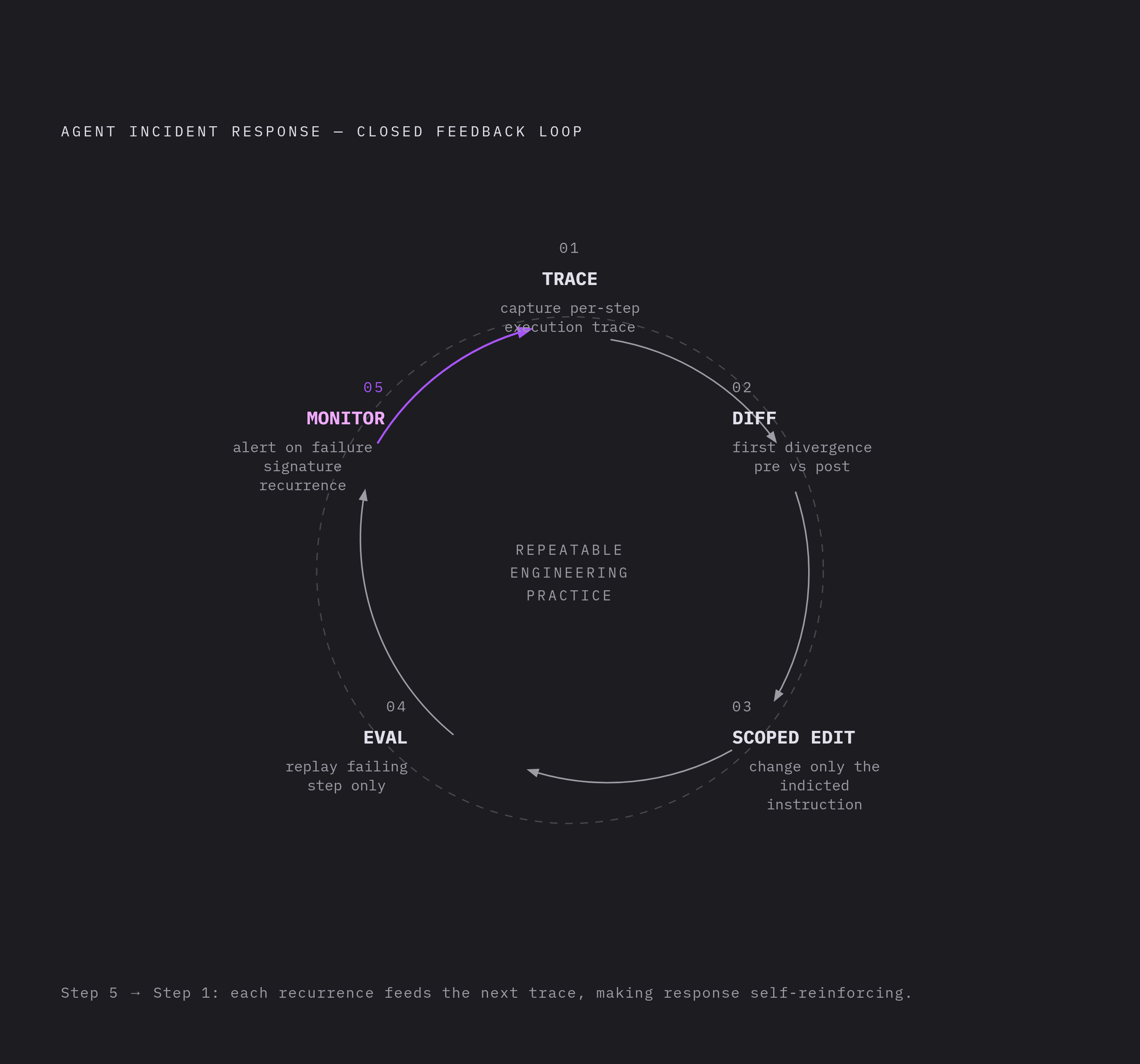
Verification continues after the fix reaches production. Group new traces by the same failure signature and alert when that pattern reappears, treating recurrence as evidence that the edit was under-scoped. This closes the feedback loop in production. Trace, diff, scoped edit, trace-derived eval, and recurrence monitoring turn incident response into a repeatable engineering practice. This way of working needs trace-level instrumentation, and teams without it still rely on intuition to choose prompt changes.